Gabriel Raya
Tilburg University · JADS Research · TU/e
Diffusion dynamics, information-guided training, and controllable generative models.
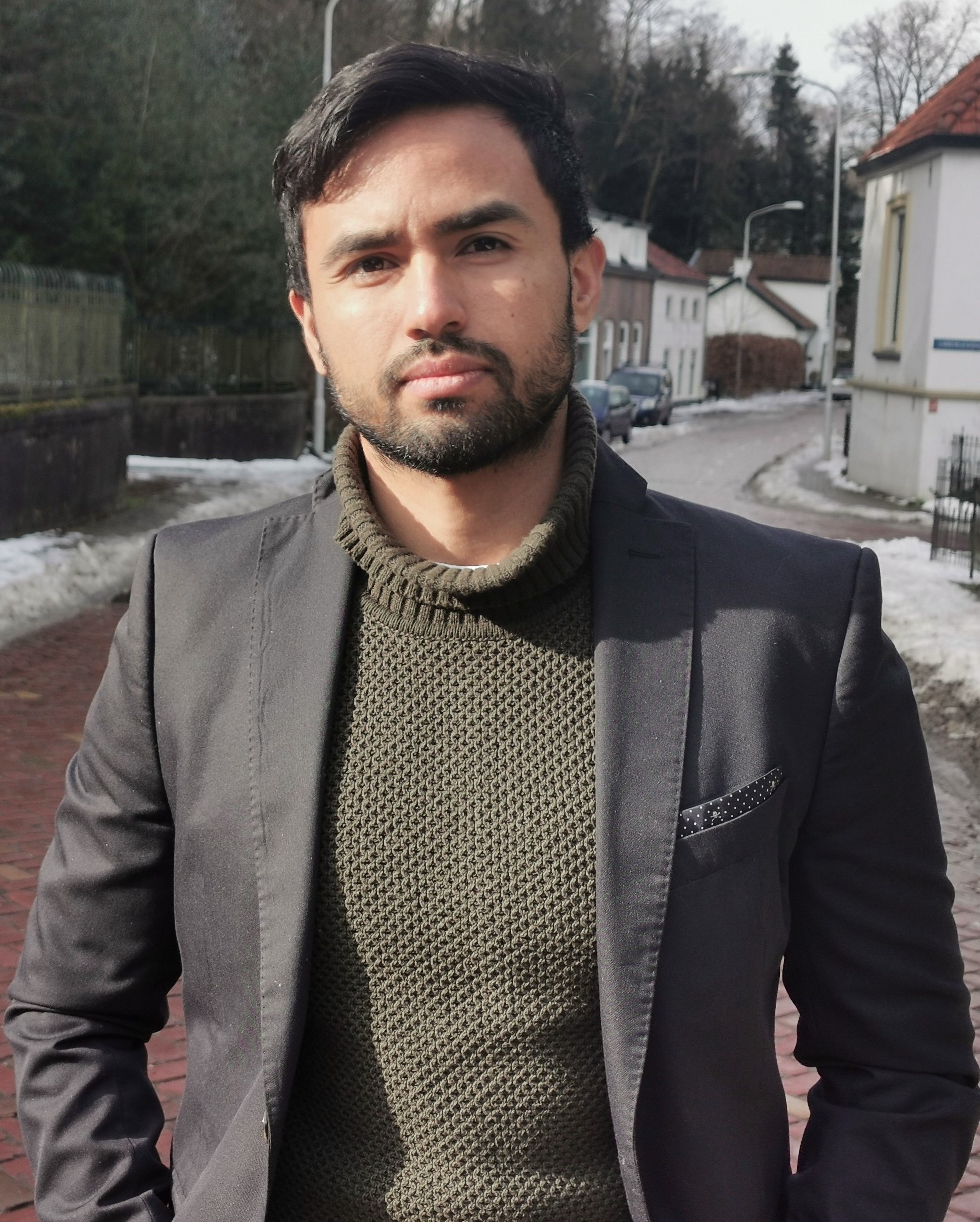
📍 The Netherlands
Where noise becomes structure. My research studies the regimes in diffusion models where uncertainty is resolved and structure becomes recoverable. These regimes are not uniform along the denoising trajectory. They shape diversity, memorization, guidance, and where training effort is useful. I develop this view through symmetry breaking in diffusion dynamics, information-guided noise allocation, and time-dependent guidance, aiming to replace heuristic choices in training and control with measurable structure along the denoising path.
I am a final-year Ph.D. researcher in Machine Learning at Tilburg University and JADS (TU/e), and a visiting researcher at the Donders Institute for Brain, Cognition and Behaviour under the guidance of Dr. Luca Ambrogioni and Prof. Dr. Eric Postma. My work combines probabilistic generative modeling, statistical physics, and information theory. I previously worked as a Research Scientist Intern on Sony AI's Foundational Models team in Tokyo, where I worked on information-guided training for generative models.
Structure formation
How diffusion trajectories move from noise to data through phases, attractors, stability changes, and symmetry breaking.
Information-guided training
Where uncertainty is resolved along the corruption path, which noise levels carry learning signal, and how schedules should allocate effort.
Generalization dynamics
How generative behavior emerges from data geometry, associative memory, and the transition from memorization to structured synthesis.
Control and robustness
How guidance, negative conditioning, efficient sampling, and diffusion-based correction behave under distribution shift.
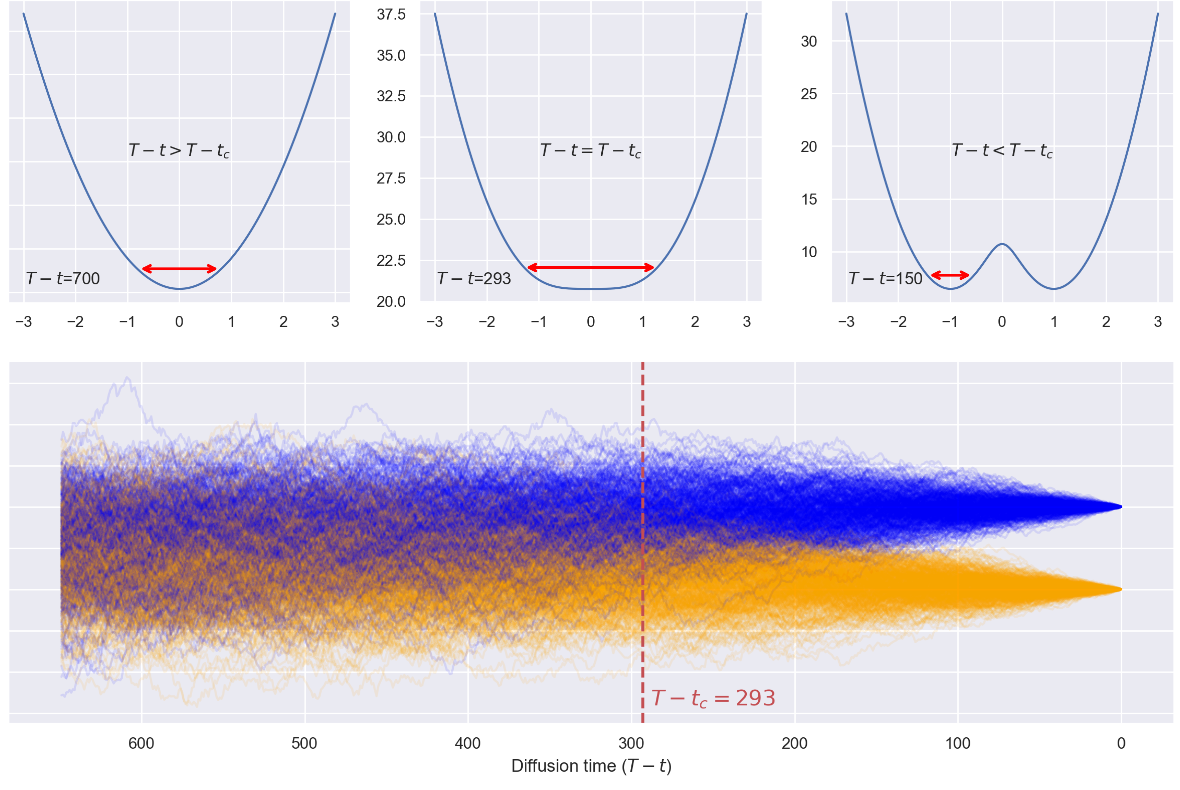
Symmetry breaking in diffusion dynamics
Diffusion generation passes through distinct dynamical regimes. Early trajectories collapse toward a central fixed point, while later dynamics break symmetry and move toward data-manifold attractors.
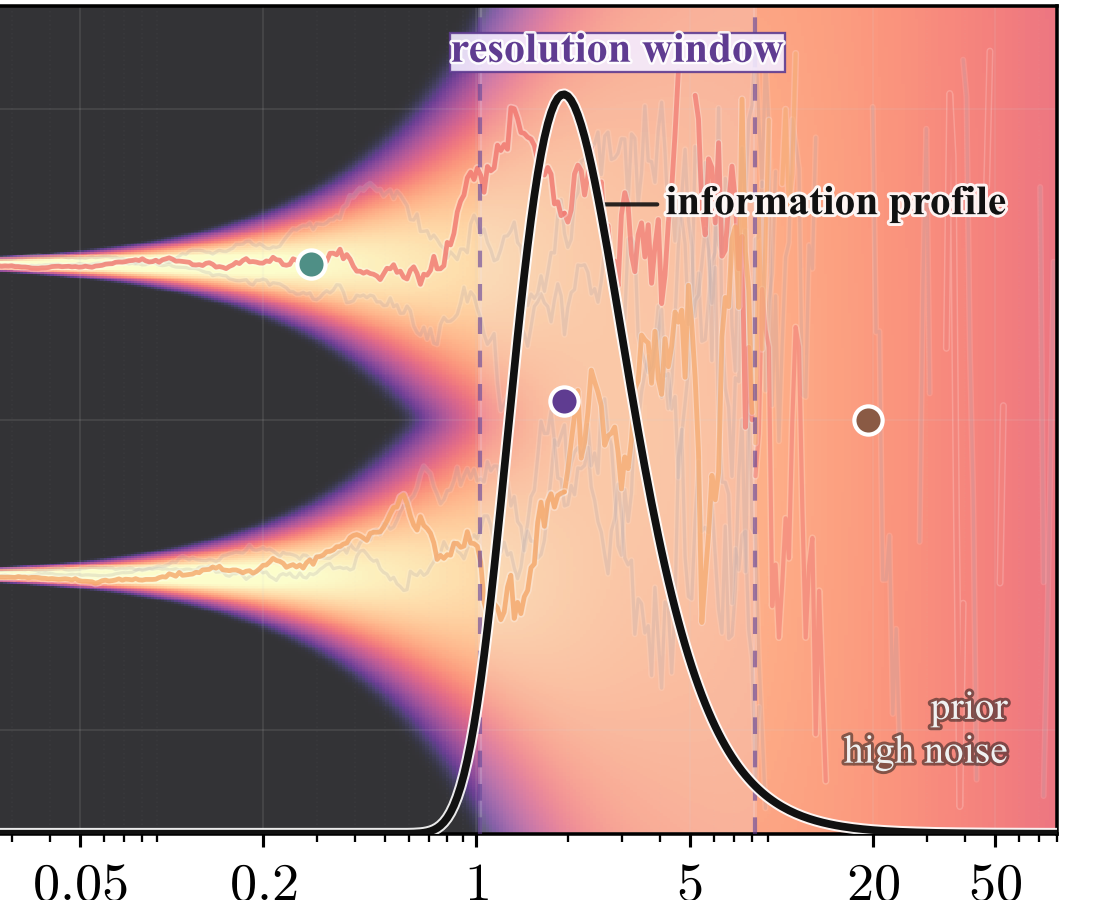
Noise scheduling as information-guided allocation
Noise schedules allocate training effort before the distribution of denoising difficulty is known. We estimate where uncertainty is resolved and adapt training toward that profile.
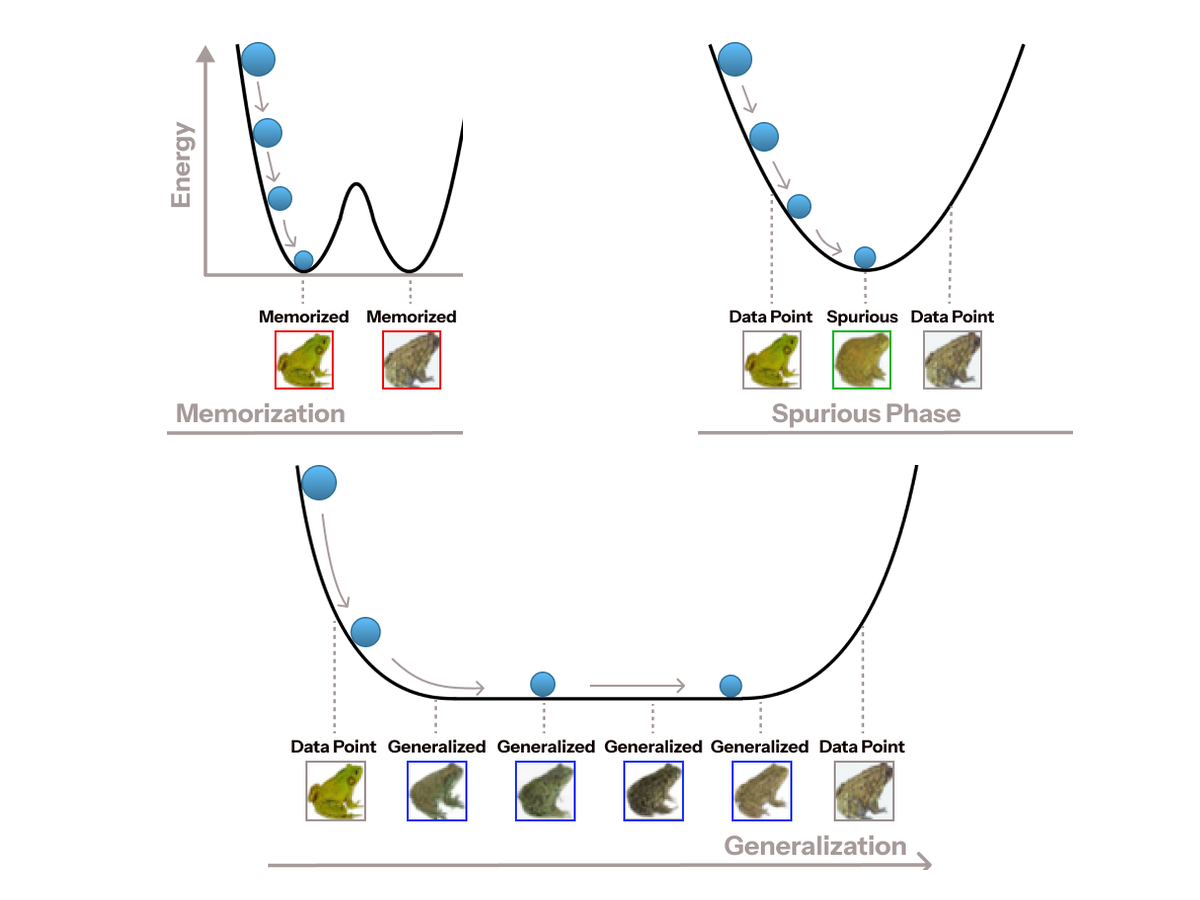
From memorization to generalization
Generative behavior can be analyzed through associative memory. Models move from storing examples to organizing them into structured, generalizing dynamics.
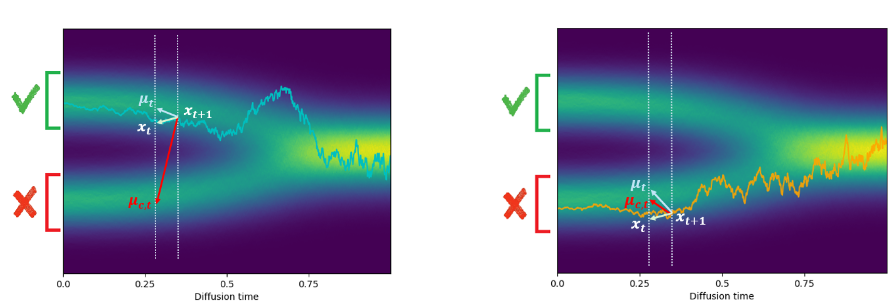
Dynamic negative guidance
Negative prompting can fail when the reverse process is non-stationary. Dynamic Negative Guidance modulates guidance across time and state to remove unwanted content more accurately.
Before my Ph.D., I obtained an M.Sc. in Computer Science at Radboud University, where I worked on unsupervised out-of-distribution detection for digital pathology with Twan van Laarhoven and Jasper Linmans. I was also a visiting researcher at the Computational Pathology Group, Radboud UMC, working on unsupervised and representation learning for histopathology with Witali Aswolinskiy and Francesco Ciompi.
selected publications
Representative papers behind this line of work; full list on the publications page.
- Dynamic Negative Guidance of Diffusion ModelsInternational Conference on Learning Representations 2025
news
| May 13, 2026 | I was recognized as a Golden Reviewer for ICML 2026. |
|---|---|
| May 25, 2025 | I completed a research internship with the Sony AI Music Foundational Model Team. |
| Nov 10, 2024 | Our workshop paper Memorization to Generalization: The Emergence of Diffusion Models from Associative Memory has been accepted as a contributed talk at SciForDL NeurIPS 2024!. |
| Nov 10, 2024 | Our workshop paper Dynamic Negative Guidance of Diffusion Models: Towards Immediate Content Removal has been accepted at SafeGenAI NeurIPS 2024!. |
| Jan 10, 2024 | Our paper Diffusion models for out-of-distribution detection in digital pathology has been accepted at the journal of Medical Image Analysis 2024!. |